Treatments
Why Use Ultrasound to Guide Injections?
For general information only. This is not medical advice. See the full disclaimer at the end of this article.
Many joint, tendon, and nerve injections used to be done "blind," by feeling for landmarks on the skin. Today, your doctor can use ultrasound to see the target and watch the needle get there. Here's why that matters for you.
At a glance
- Ultrasound shows muscles, tendons, nerves, and blood vessels in real time, with no radiation.
- Your doctor can see the needle tip and steer it around nerves and blood vessels.
- It's especially helpful for small targets, deep targets, and treatments near nerves.
- It has limits. It can't see through bone, and very deep targets can be hard to see.
What ultrasound does well
- Soft tissue detail. For tendons, nerves, and muscles, ultrasound often shows finer detail than MRI.
- Motion. Ultrasound can watch a tendon slide or a nerve snap out of place as you move. MRI can't.
- Finding the problem and treating it in the same visit. Your doctor can look, confirm the target, and treat you in one visit.
- No radiation, no dye.
How your doctor watches the needle
An ultrasound probe sends out a very thin "slice" of sound. To see the whole needle, your doctor lines the needle up with that slice. This is called the in-plane approach.
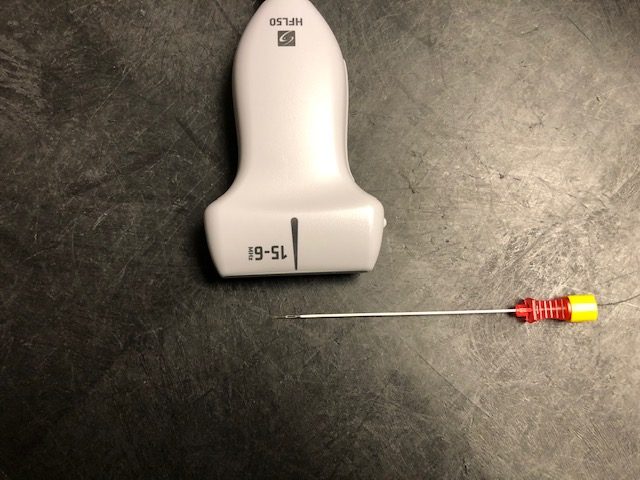
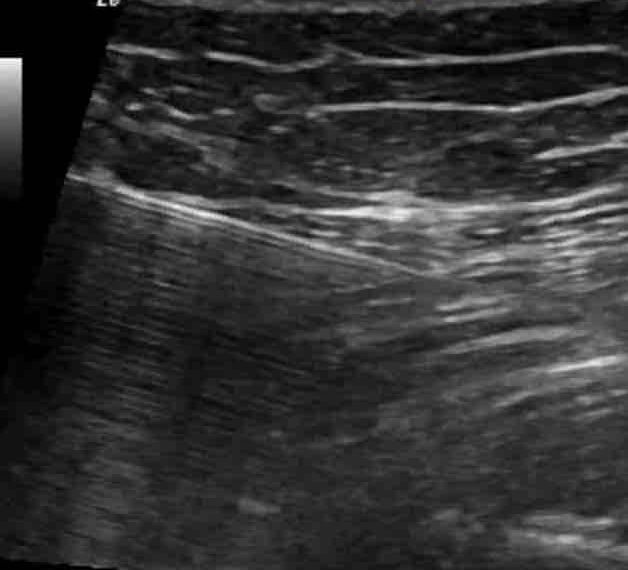
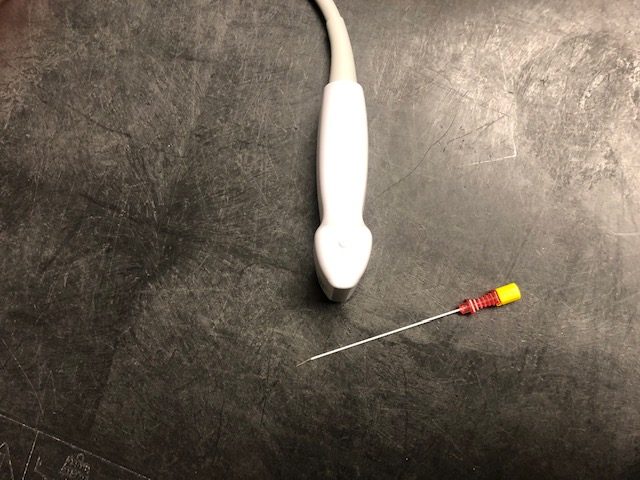
For small or shallow targets, the needle may cross the slice instead. This is the out-of-plane approach. Only a dot shows on the screen, so your doctor moves the probe and needle together carefully to track the tip.
When ultrasound guidance helps most
- Targets close to nerves or blood vessels
- If you bruise or bleed easily
- Small structures, like tendon sheaths in the hand or small nerves
- Treatments that need exact placement, like PRP into a damaged part of a tendon, or freeing a pinched nerve with fluid (hydrodissection)
- When you want to avoid radiation or contrast dye
- Procedures that break up or clear tissue, like rinsing out calcium deposits in a shoulder tendon (barbotage) or freeing scar tissue (scar hydrodissection)
Does it make a difference?
In the shoulder, a review comparing ultrasound-guided and "blind" injections found ultrasound was more accurate for the AC joint (about 94% versus 68%), biceps tendon sheath (87% versus 27%), and ball-and-socket joint (93% versus 73%). Ultrasound-guided injections also gave more pain relief for the bursa and biceps tendon. In the hip, unguided joint injections miss in a large share of cases. See Shoulder Injections.
Its limits
- Sound doesn't pass through bone, so some targets inside joints or the spine are better seen with X-ray (fluoroscopy).
- Very deep targets, especially in larger bodies, can be harder to see clearly.
- Results depend on the skill and training of the person holding the probe.
What it feels like
You lie or sit comfortably. The skin is cleaned, and gel is put on the probe, which is often covered with a sterile sleeve. Your doctor scans first to plan the path, then numbs the skin and does the injection while watching the screen. Most procedures take only a few minutes.
Common questions
Are ultrasound-guided injections more accurate?
Yes, for many joints and tendons. In the shoulder, ultrasound guidance was more accurate for the AC joint, biceps tendon sheath, and ball-and-socket joint than injections without guidance.
Does an ultrasound-guided injection involve radiation?
No. Ultrasound uses sound waves, not X-rays, so there's no radiation.
Sources
- Finnoff JT, et al. American Medical Society for Sports Medicine (AMSSM) position statement: interventional musculoskeletal ultrasound in sports medicine. PM R. 2015;7(2):151-168.
- Jacobson JA. Fundamentals of Musculoskeletal Ultrasound. 3rd ed. Elsevier; 2017.
- Chen Y, et al. A review of ultrasonography in the diagnosis of carpal tunnel syndrome and a proposed scanning protocol. J Ultrasound Med. 2016;35(11):2311-2324.
- Aly AR, Rajasekaran S, Ashworth N. Ultrasound-guided shoulder girdle injections are more accurate and more effective than landmark-guided injections: a systematic review and meta-analysis. Br J Sports Med. 2015;49(16):1042-1049.
Based on Dr. Chen's lecture: Lecture: Ultrasound-Guided Procedures: The Why and the How.
This article is for general information and education only and does not constitute medical advice. It is not a substitute for an evaluation, diagnosis, or treatment by a qualified healthcare provider. Reading this article does not create a doctor–patient relationship. Every person is different; talk with your own doctor before making decisions about your care. If you think you have a medical emergency, call 911.
