Nerve pain
Radial Nerve Problems: Non-Surgical Treatment Options
For general information only. This is not medical advice. See the full disclaimer at the end of this article.
The radial nerve runs down the back of your upper arm, wraps around the elbow, and splits into two branches. It powers the muscles that straighten your elbow, wrist, and fingers, and carries feeling from the back of your hand and thumb. It can be injured or pinched in several places, and each place causes a different pattern. For an overview, see Radial Nerve Problems. This article focuses on treatments other than surgery.
At a glance
- The radial nerve is the arm nerve most often hurt by injury, especially a broken upper arm bone.
- Outside of injury, it can be pinched at the elbow (radial tunnel and PIN syndromes) or the wrist (Wartenberg's syndrome).
- Ultrasound can find the exact spot and show a swollen or pinched nerve.
- Most people do well. Splints, therapy, and ultrasound-guided injections help many avoid surgery.
Where the radial nerve gets into trouble
| Problem | Where | What you notice |
|---|---|---|
| Crutch palsy | Armpit | Weakness after leaning on crutches |
| Upper arm injury or "Saturday night palsy" | Spiral groove of the upper arm bone | Wrist drop (can't lift the wrist or fingers) after a fracture or sleeping with the arm draped over a chair |
| Radial tunnel syndrome | Just below the elbow, in the forearm muscles | Aching in the outer elbow and forearm without weakness. Often mistaken for tennis elbow. |
| Posterior interosseous nerve (PIN) syndrome | Where the nerve dives under the supinator muscle (the arcade of Frohse) | Painless weakness lifting the fingers and thumb; the wrist still lifts but drifts toward the thumb side |
| Wartenberg's syndrome (cheiralgia paresthetica) | Superficial radial nerve at the wrist | Burning, numbness, or tingling on the back of the thumb and hand. Often from a tight watch, bracelet, handcuffs, or an IV. |
How ultrasound helps
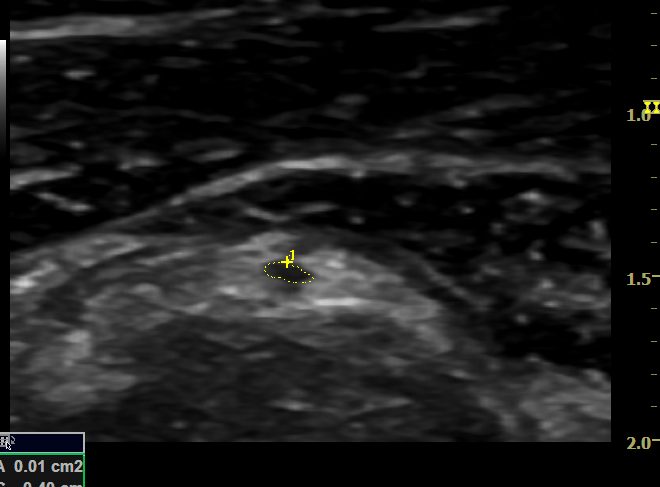
Ultrasound lets your doctor follow the nerve along its whole path and compare it with your other arm. A pinched nerve often looks swollen just before the tight spot, and may look narrowed like an hourglass at the spot itself. Watching the nerve while you move your arm can show where it's caught. Ultrasound also helps your surgeon plan if surgery is needed. In arm fractures, ultrasound matched what surgeons found in more than 9 out of 10 cases.
Nerve tests (EMG and nerve conduction studies) show how badly the nerve is affected and help predict recovery.
Non-surgical treatment
- Protect the nerve: avoid pressure on the arm, a tight watch, or repeated forceful twisting of the forearm.
- Splinting: a wrist or finger splint keeps you functional while the nerve recovers from a wrist drop.
- Therapy: keeping joints flexible, nerve gliding, and strengthening as the nerve recovers.
- Steroid injection: near the pinched spot, for radial tunnel syndrome or Wartenberg's syndrome. A single injection gave long-term relief for some people with radial tunnel syndrome.
- Nerve hydrodissection: fluid placed under ultrasound to gently free the nerve from tight tissue. In a case series of radial tunnel syndrome, hydrodissection at the arcade of Frohse both confirmed the diagnosis and relieved pain. In one case of PIN palsy from fibrous bands, years of finger weakness recovered after hydrodissection. See Nerve Hydrodissection.
- Dextrose (sugar water) around the nerve: in a case of radial nerve palsy, two sessions of dextrose injected around the nerve were followed by recovery of strength and nerve test results at 4 months. Dextrose may calm irritated nerves.
- Nerve blocks: to confirm that the radial nerve is carrying the pain.
Surgery is needed for a nerve that's cut, twisted, or doesn't recover as expected. Get checked promptly for new or worsening weakness.
See also Ulnar Nerve Problems: Non-Surgical Treatment and The Median Nerve Beyond Carpal Tunnel.
Sources
- Xiao TG, Cartwright MS. Ultrasound in the evaluation of radial neuropathies at the elbow. Front Neurol. 2019;10:216.
- Malikowski T, Micklesen PJ, Robinson LR. Prognostic values of electrodiagnostic studies in traumatic radial neuropathy. Muscle Nerve. 2007;36(3):364-367.
- Esparza M, Wild JR, Minnock C, et al. Ultrasound evaluation of radial nerve palsy associated with humeral shaft fractures to guide operative versus non-operative treatment. Acta Med Acad. 2019;48(2):183-192.
- Chen SR, Shen YP, Ho TY, et al. Ultrasound-guided perineural injection with dextrose for treatment of radial nerve palsy: a case report. Medicine (Baltimore). 2018;97(23):e10978.
- Won SJ, Kim BJ, Park KS, et al. Reference values for nerve ultrasonography in the upper extremity. Muscle Nerve. 2013;47(6):864-871.
Based on Dr. Chen's lecture: Lecture: Radial Neuropathy: Nonsurgical Considerations.
This article is for general information and education only and does not constitute medical advice. It is not a substitute for an evaluation, diagnosis, or treatment by a qualified healthcare provider. Reading this article does not create a doctor–patient relationship. Every person is different; talk with your own doctor before making decisions about your care. If you think you have a medical emergency, call 911.
