Knee
Hidden Causes of Pain That Ultrasound Can Find
For general information only. This is not medical advice. See the full disclaimer at the end of this article.
Most joint and tendon pain comes from common problems like tendinopathy, arthritis, or a sprain. But sometimes pain keeps going because the real cause hasn't been found. Ultrasound in the exam room lets your doctor look closely at a painful spot, compare it with the other side, and watch it move. That makes it good at finding less common causes. Here are some I look for.
At a glance
- Ultrasound shows tendons, nerves, muscles, and small bones in real time, while you move.
- It can find problems that are easy to miss, like small extra bones, nerve swellings, and partial tears.
- It can guide a diagnostic numbing injection on the spot to confirm the source.
Knee
Fabella syndrome
A fabella is a small, extra bone inside the tendon at the back-outside of the knee. About 10 to 30 percent of people have one, and it's more common in people of Asian descent. Usually it causes no trouble. But it can rub against the thighbone and cause pain at the back of the knee, especially when straightening the leg fully. Ultrasound shows the fabella and can guide an injection right to it.
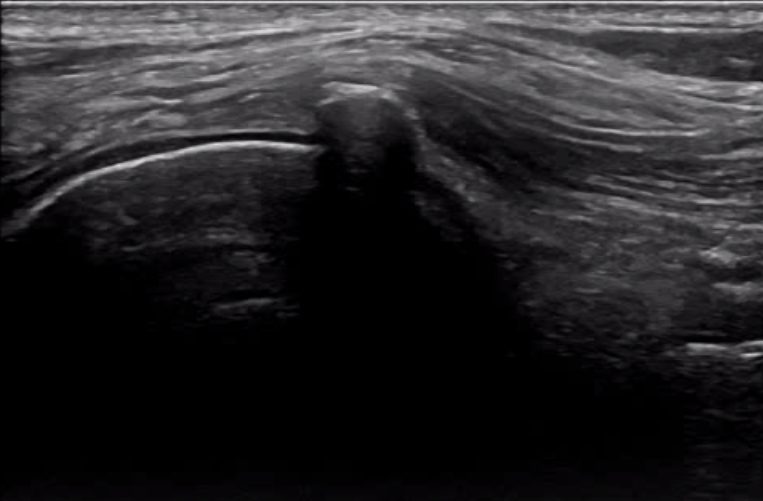
Medial plica syndrome
A plica is a fold of the knee's joint lining left over from before birth. If it thickens, it can snap over the inner edge of the kneecap and cause pain and clicking. It's hard to see on most scans. Therapy and an injection help many people; a few need arthroscopic surgery to remove it.
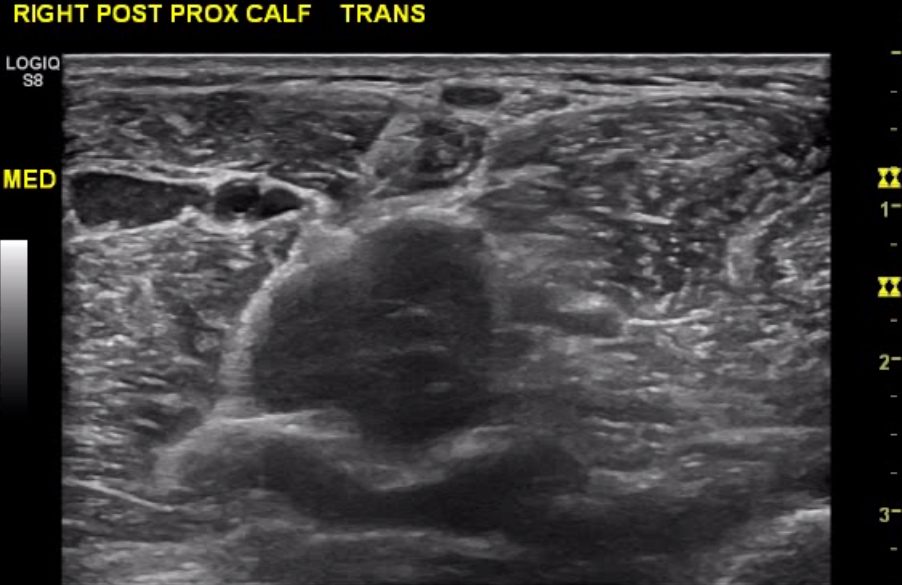
Nerve sheath tumor
Rarely, a lump on a nerve, such as a schwannoma or neurofibroma, causes pain, tingling, or a tender lump. These are usually benign. Ultrasound shows the nerve going into and out of the lump, which points to the diagnosis. An MRI and a specialist visit follow.
Hip and thigh
- Rectus femoris tear: the front thigh muscle that crosses the hip can tear near its top, often in kicking or sprinting sports. Ultrasound shows the tear, the blood pocket, and later the scar. Testing while you tighten the muscle helps find small tears.
- Lateral femoral cutaneous nerve neuroma (meralgia paresthetica): burning and numbness on the outer thigh from a pinched skin nerve near the front of the hip bone. Ultrasound can show a swollen nerve and guide a nerve block or hydrodissection.
- Femoral hernia: a hernia low in the groin can cause groin pain. Ultrasound can show it as you cough or strain.
Shoulder and elbow
- Suprascapular nerve pinched by a cyst at the back of the shoulder, causing deep shoulder ache and weakness. See Shoulder Injections.
- Ulnar nerve slipping over the elbow bone when you bend your arm, seen only on a moving exam. See Ulnar Nerve at the Elbow.
- Biceps tendon tear at the elbow.
Ankle and foot
Os peroneum problems
The os peroneum is a small extra bone inside the peroneus longus tendon on the outer foot. If it cracks or the tendon tears around it, pain on the outer foot can linger after an ankle injury. Missing it can lead to long-term ankle instability. X-ray and ultrasound together help find it.
Plantar fascia rupture
A sudden "pop" with pain in the arch can mean the plantar fascia has torn, sometimes after steroid injections for plantar fasciitis. Ultrasound shows the gap. Most heal with a boot and time.
Achilles problems
Ultrasound can tell Achilles tendinosis, irritation of the tissue around the tendon, and partial or full tears apart.
Plantar fasciitis versus inflammatory arthritis
Heel pain in both feet, with erosion of the heel bone or lots of blood flow on ultrasound, can be a sign of inflammatory arthritis (spondyloarthritis) rather than ordinary plantar fasciitis. See Inflammatory Arthritis.
Read more in What Can a Musculoskeletal Ultrasound Show?
Sources
- Jacobson JA. Fundamentals of Musculoskeletal Ultrasound. 3rd ed. Elsevier; 2018.
- Driessen A, Balke M, Offerhaus C, et al. The fabella syndrome: a rare cause of posterolateral knee pain: a review of the literature and two case reports. BMC Musculoskelet Disord. 2014;15:100.
- Reynolds DL Jr, Jacobson JA, Inampudi P, et al. Sonographic characteristics of peripheral nerve sheath tumors. AJR Am J Roentgenol. 2004;182(3):741-744.
- Brigido MK, Fessell DP, Jacobson JA, et al. Radiography and US of os peroneum fractures and associated peroneal tendon injuries: initial experience. Radiology. 2005;237(1):235-241.
- Fessell DP, Jacobson JA. Ultrasound of the hindfoot and midfoot. Radiol Clin North Am. 2008;46(6):1027-1043.
Based on Dr. Chen's lecture: Lecture: The Application of Ultrasound in Common and Uncommon Musculoskeletal Conditions.
This article is for general information and education only and does not constitute medical advice. It is not a substitute for an evaluation, diagnosis, or treatment by a qualified healthcare provider. Reading this article does not create a doctor–patient relationship. Every person is different; talk with your own doctor before making decisions about your care. If you think you have a medical emergency, call 911.
