Hip & Pelvis
Pain in the Buttock: 11 Possible Causes and How We Sort Them Out
For general information only. This is not medical advice. See the full disclaimer at the end of this article.
"It hurts right here," you might say, pointing to your buttock. But many different problems can cause pain in the same spot. Some start in the buttock itself. Others start in the lower back. Getting the right treatment depends on finding the real source. This article walks through the most common causes. It is based on a lecture I give to doctors.
At a glance
- At least 11 different problems can cause buttock pain.
- Where it hurts, what makes it worse, and a careful exam point to the cause.
- Ultrasound helps us see tendons, muscles, and nerves and guide injections precisely.
- Most causes start with physical therapy. Injections, nerve treatments, or surgery come later if needed.
Causes that start in the buttock and hip
- Sacroiliac (SI) joint pain. The SI joint connects your spine to your pelvis. Pain is usually on one side, just below the belt line near the dimple in your lower back. It causes about 15 to 30 out of 100 cases of long-lasting low back and buttock pain. Pregnancy, a past fall, or a prior spine fusion raise the risk.
- Piriformis syndrome. The piriformis is a muscle deep in the buttock near the sciatic nerve. Irritation here can cause buttock pain that spreads down the leg, a lot like sciatica.
- Ischiofemoral impingement. A muscle gets pinched between the "sit bone" and the top of the thigh bone. It causes deep buttock or groin pain, often with long strides. It is more common in women.
- Ischial bursitis. A small fluid sac over the sit bone gets irritated. It hurts mostly when sitting, especially on hard seats or a bike.
- High hamstring tendinopathy. The hamstring tendon wears down where it attaches to the sit bone. It is common in runners. It hurts with sitting, running uphill, and sprinting.
- High hamstring tear. A sudden injury, often from sprinting, water skiing, or dance. You may feel a pop, see bruising on the back of the thigh, and feel weak. Get this checked quickly. Large tears do better when repaired within about 4 weeks.
- Superior gluteal nerve entrapment. A pinched nerve above the piriformis. It can cause buttock pain and weakness in the muscles that steady your hip when you walk.
Causes that start in the lower back
- Spinal stenosis. The space around the nerves in the low back narrows with age. Pain and heaviness in both buttocks and legs come on with standing or walking. It eases when you sit or lean forward, like on a shopping cart.
- Facet joint arthritis. Arthritis in the small joints of the spine. Back and buttock pain is worse when you lean back or twist.
- Pinched nerve (radiculopathy). Often from a slipped disc. Leg pain, often below the knee, is usually worse than back pain. You may have numbness or weakness.
- Inflammatory arthritis. Conditions like ankylosing spondylitis. Clues include pain that starts before age 45, morning stiffness lasting more than 30 minutes, pain that gets better with exercise, and buttock pain that switches sides.
How we find the cause
- Your story. Exactly where it hurts, what makes it worse, and what makes it better.
- A focused exam. Specific movement tests can point to one cause or another. For example, a group of SI joint tests is very good at ruling out the SI joint when they're negative.
- Imaging when needed. MRI is best for the spine and for grading hamstring tears. Ultrasound is great for tendons, muscles, bursas, and nerves. It also lets us check how things move.
- Diagnostic injections. Numbing a specific spot under ultrasound or X-ray guidance can confirm the source of pain.
One important point: X-rays and MRIs often show "wear and tear" in people with no pain at all. Imaging results must match your symptoms and exam.
How it's treated
Start with conservative care. For most of these problems, the first step is physical therapy and changing your activities. For example, a hamstring exercise called the Nordic curl can cut the risk of a hamstring injury by about half.
Then step up if needed. Options depend on the cause:
- Ultrasound-guided injections into a joint, bursa, tendon, or muscle
- Botox shots for some muscle problems
- Shockwave therapy for hamstring tendon pain
- Nerve ablation for SI joint or facet joint pain
- Spine (epidural) shots for pinched nerves or a narrow spine
- Surgery for large tears or cases that don't improve
When to get help right away
Go to the emergency room if buttock or back pain comes with any of these:
- New trouble controlling your bladder or bowels
- Numbness in the groin or inner thighs
- Leg weakness that is getting worse
- Fever, or pain after a major fall or injury
Finding the real source of pain comes first. The right treatment follows from the right diagnosis.
Buttock pain causes side by side
| Condition | Where it hurts | Exam clues | First treatments | Procedures |
|---|---|---|---|---|
| Sacroiliac (SI) joint | One side, below the belt line, over the dimple | Points to the SI joint; 3 or more positive SI tests | Core and pelvic PT, SI belt | Joint injection, lateral branch ablation |
| Piriformis syndrome | Deep buttock, worse sitting | Pain with hip rotation stretches | Stretching, soft tissue work | Ultrasound-guided injection, Botox |
| Ischiofemoral impingement | Deep buttock or hip, worse with long strides | Pain with long-stride walking | Hip-balance PT, shorter strides | Ultrasound-guided injection |
| Ischial bursitis | Sit bone, worse sitting on hard seats | Tender sit bone, hamstring strength normal | Cushion, avoid hard seats | Ultrasound-guided injection or drainage |
| High hamstring tendinopathy | Sit bone, worse running, sitting, and bending | Pain with hamstring stretch tests | Heavy, slow loading program | Shockwave, PRP |
| High hamstring tear | Sudden pain at the back of the thigh, bruising | Weak knee bending, a gap | Rehab if not pulled away from the bone | Surgery if 2 or more tendons are torn or retracted |
| Superior gluteal nerve | Buttock and outer hip, with a weak hip | Hip drops when standing on that leg; tender notch above the piriformis | Hip strengthening, gait training | Nerve block; rarely surgery |
| Low back sources (stenosis, facet joints, pinched nerve) | Buttock pain that starts in the back | Changes with back movement | PT | Epidural or facet procedures |
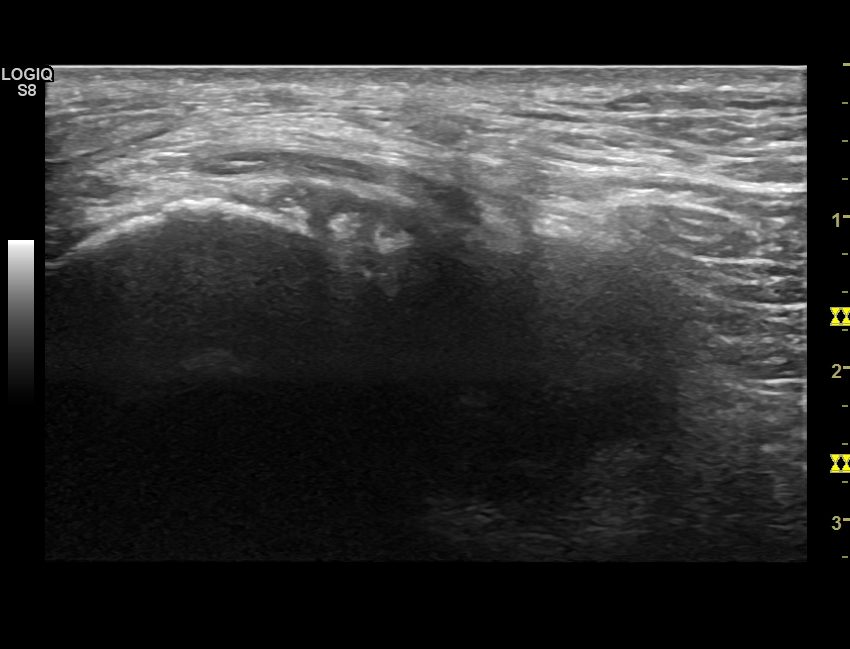
Superior gluteal nerve entrapment
The superior gluteal nerve leaves the pelvis just above the piriformis muscle and powers the hip muscles that keep your pelvis level when you walk (gluteus medius and minimus). If it's pinched, you may have buttock and outer hip pain with a weak hip, and your pelvis may drop on the other side when you stand on the affected leg. It's easy to confuse with piriformis syndrome or an L5 pinched nerve. An MRI rules out spine problems. Treatment includes hip strengthening and an ultrasound-guided nerve block, with surgery rarely needed.
Treating the SI joint's nerves
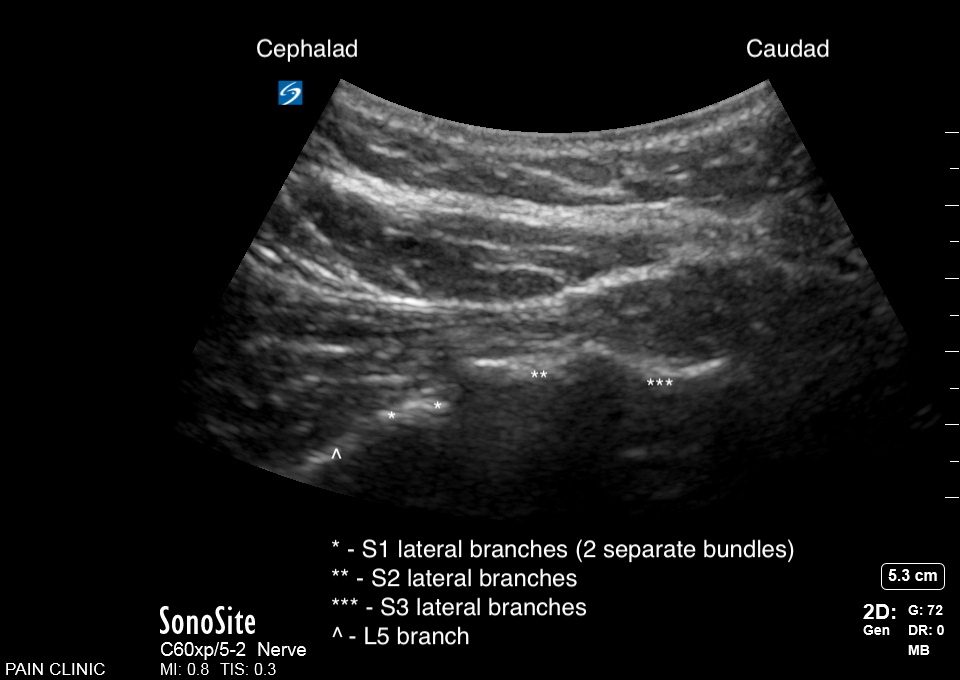
When an SI joint injection helps but the relief doesn't last, the small nerves (lateral branches) that carry pain from the back of the joint can be numbed and then treated with radiofrequency ablation.
When back and buttock pain come with morning stiffness that improves with exercise, see Inflammatory Arthritis. For when buttock and leg pain aren't coming from the spine, see When Sciatica Isn't From Your Spine.
Sources
- Chen Y. Buttock pain: a diagnostic & interventional approach. Physical Medicine & Rehabilitation lecture.
- Laslett M, et al. Man Ther. 2005.
- Cacchio A, et al. Am J Sports Med. 2011.
- Torriani M, et al. Ischiofemoral impingement syndrome: an entity with hip pain and abnormalities of the quadratus femoris muscle. AJR. 2009.
This article is for general information and education only and does not constitute medical advice. It is not a substitute for an evaluation, diagnosis, or treatment by a qualified healthcare provider. Reading this article does not create a doctor–patient relationship. Research results described here come from small studies or published reviews and may not apply to you. Every person is different; talk with your own doctor before making decisions about your care. If you think you have a medical emergency, call 911.
